
Learning Through Refinement
Learning through refinement: situating concepts and knowing what you don’t know
The main problem is: when I want to learn a topic, I need to be able to situate each new concept/fact I learn in its broader context. I need to be able to see how my new knowledge has ‘refined’ a previously blurry picture of the field. Instead I often encounter new concepts/facts about a field that feel divorced from each other. I don’t understand their relation, what binds them together… eventhough I feel intuitively that these concepts do somehow relate to each other. I also don’t have a clear sense of what I don’t yet know - each new concept arrives ‘out of the blue’.
Textbooks provide a solution to this problem, but require immense time investment to cover the introductory chapters and grind through the comprehensive material.
Shorter texts (popular science/history books, wikipedia, ‘very short introductions’) help (a bit) with the problem of time investment.. but they still lack a way of knowing how much you don’t know or situating new knowledge in a larger network of ideas. Often popular science/history books oversimplfiy (as is needed) but they don’t show the reader how far their oversimplification has gone or the ‘location’ of the idea in the broader field. Wikipedia provides a lot of detail, but their relation is not clear.
Here’s a useful analogy from Better Explained:
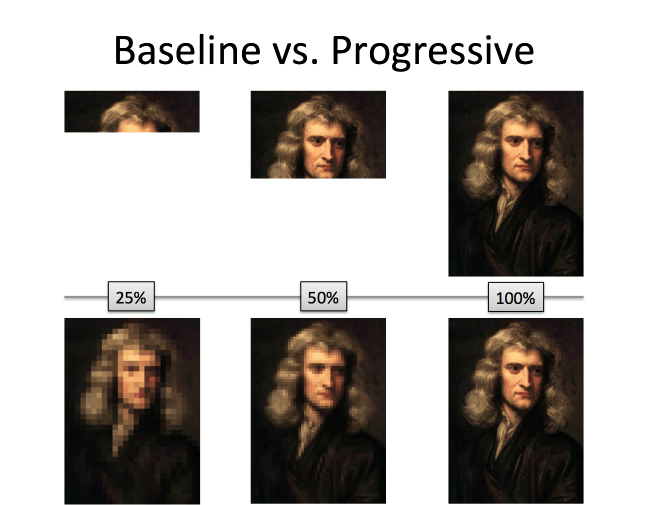 A textbook feels like the first type, you scan through at high resolution from start to end. You pick up the relationship between parts of the image at the same time as you learn the highest level of detail about that part of the image. This requires a lot of energy and time investment, and also if details are forgotten about the relation between the facts may break.
Whereas I’m advocating learning in a manner akin to the 2nd type in the above image. The first image is blurry, but it is still a complete picture. The blurriness of the image indicates to you how much you don’t know. Nevertheless you can still learn something from this picture: the main parts of the image, and the relation between the parts of the image. Then learning proceeds by refining this picture. The whole image need not be refined at the same time, instead you could focus on the nose and make that part of the image less blurry. As you focus on the nose, you are acquiring more and more ‘detail’ about the image but you’re also learning about the relationship between the (newly refined) nose, and the blurry head and surrounding. You’re also learning about the relative level of information you know about the nose vs everything else. In this sense you can situate your new knowledge (the nose) within its broader context (the face & surroudings), always keeping an eye on this broader picture. At the same time you know how much you don’t know: you know that you don’t know much about the rest of the face or the surrounding. You could choose then to ‘refine’ that part of the image.
What you’re left with is a picture with some portions in detail, and other portions left blurry. These ‘islands’ of detail feel like the current forms of knowledge found online: scientific papers, textbook chapters, lectures. But what has been missing in the ever-present reminder of the blurry parts: the parts of the field you don’t know about yet, and the relations between what you do know, and what you only know a little bit about.
How do we achieve this? Let’s say I want to learn about History. I would ideally read the following sequence of documents:
- A 1 page complete summary of History
- A 5 page complete summary of History
- A 50 page complete summary of History
- A 100 page complete summary of History
- A 500 page complete summary of History
- A 1000 complete summary of History (e.g. a textbook)
As I progress from 1 to 6 I have a clear idea of what concepts are being refined on, and what the relationships are between the concepts. Each document provides a ‘complete’ summary of the topic within that level of granularity. Then, as I ‘zoom in’, I would know how to situate each new idea/concept/fact I learn in the larger ‘skeleton’ of ideas. As I proceed I would keep adding detail to the image that I became acquainted with in the first stage.
Ideally I would be able to choose interactively which parts of the ‘image’ I want to refine. Also if I ‘zoom in’ to one part of this space, it would be obvious to me what other part of the space is affected by what I just learned.
What are some challenges for this?
- Structuring knowledge in a hierarchical way. The upper level would need to naturally ‘lead into’ the more refined level. If we apply this image analogy directly, we would need to be able to define concepts and their relations in a 2D space, with distance in this space corresponding to some level of similarity/relevance. We would also need a concept of ‘blurriness’. Blurriness could possibly be solved by the page-number restriction.
- We would need some way to indicate intuitively to people (graphically?) the space of concepts and the level of knowledge you have about something. A 2D map of a field?
- We would need to be able to quantify ‘level of knowledge’. Can concepts be placed into an ordering where one end is ‘blurry’ and the other end is ‘detailed’?
- We would need to ensure that people are always able to keep the top level blurry (but complete) overview in mind without much effort. They would need to refer to it constantly to situate their new understanding. After a while this high-level overview would become internalised. The high-level ideas could be memorised using Anki, for example.
One implementation:
One way to implement this idea of blurry-to-detailed explanation is to use a Question & Answer framework, where there are multiple Answers which get progressively more and more refined in detail. For example,
Question: What is a neuron? Answer 1: A cell in the nervous system Answer 2: A cell in the nervous system with a special shape, and electrical properties that permit neurons to communicate with each other. Answer 3: A cell in the nervous system which comprises a long extended projection (called an ‘axon’) which carries electrical signals (‘action potential’) from the cell body. Chemicals (‘neurotransmitters’) are released at the axon tip and move to another neuron to trigger electrical activity. Answer 4: A cell in the nervous system comprising a single axon and multilpe dendrites. Action potentials form at the base of the axon and move to the axon terminal where they induce neurotransmitter release. Neurotransmitters bind to the dendritic terminal of another neuron triggering electrical activity in the target neuron. Answer 5: ….etc